From Egg to Butterfly - a Life Cycle
I’m excited to share a fun, creative, and meaningful learning project: creating the life cycle of a butterfly. This simple yet charming craft connects beautifully to several learning domains, turning an art activity into a rich educational experience that children truly enjoy.
From an early age, children are encouraged to explore and make sense of the world around them. Nature offers the perfect entry point, and this activity introduces the basic concept of life cycles, an essential foundation in early science learning. Through hands-on exploration, children discover the incredible transformation of a butterfly, from a tiny egg to a magnificent winged insect, and begin to understand the wonder of metamorphosis.
As children carefully glue the bean “eggs” and the pasta “caterpillar,” they strengthen fine motor skills, hand-eye coordination, and precision. Beyond science and motor development, this activity also nurtures creativity and imagination. Cutting, gluing, and arranging the different stages allows each child to create their own interpretation of nature’s process, encouraging independence and creative thinking.
In our classroom, we connected this project to The Very Hungry Caterpillar, but it can also be linked to broader themes of cycles and change, such as the water cycle or other repeating processes in nature.
Materials needed:
Paper plate
White beans
Rotini pasta
Shell pasta
Bow tie pasta
Hot glue
Two leaves
A small stick
How to create the life cycle
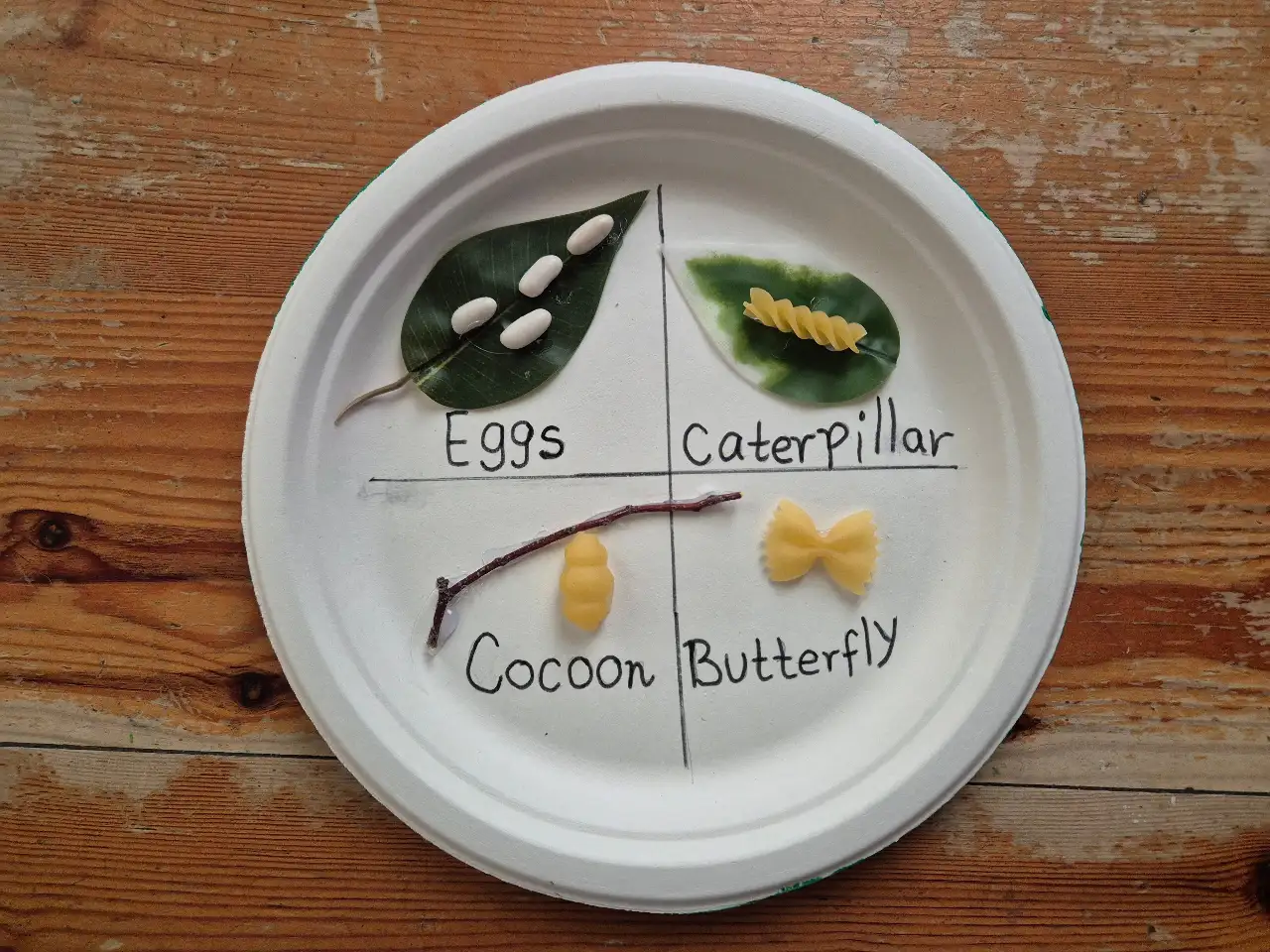
Divide the paper plate into four equal sections.
In the first section, glue a leaf and place the white beans on top to represent the eggs.
In the second section, glue another leaf and add the rotini pasta to create the caterpillar.
In the third section, glue a small stick, and next to it attach the shell pasta to form the cocoon.
Finally, in the fourth section, glue the bow tie pasta to represent the butterfly.
You can also label each stage to reinforce vocabulary and understanding.
This hands-on project is a beautiful way to combine science, literacy, creativity, and fine motor development, all through playful learning.