
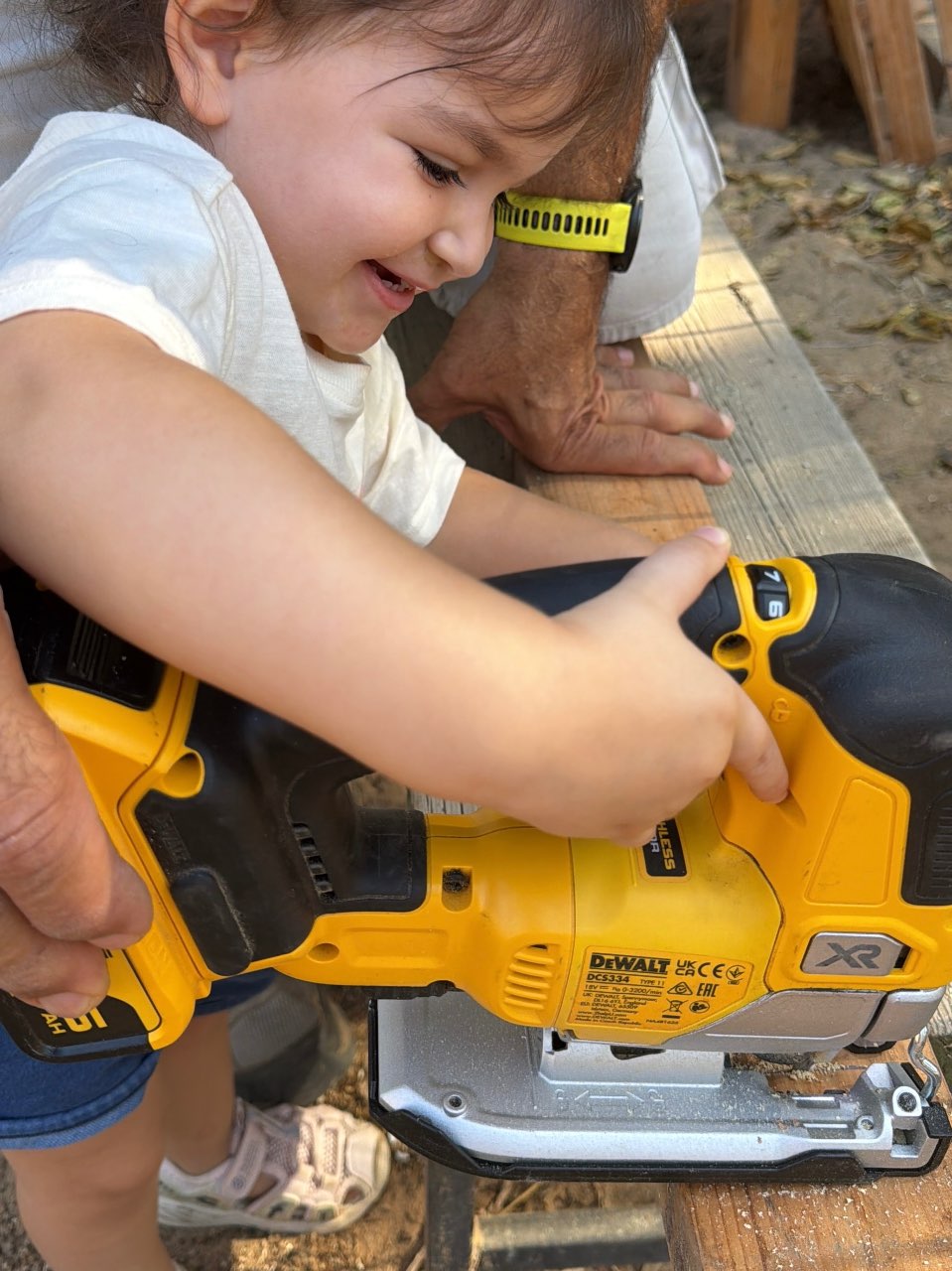
When Toddlers Become Builders: A Hands-On Woodworking and Nature Project
What happens when you give toddlers wood, tools and a real building challenge?
They plan, cooperate, solve problems and take their construction responsibilities very seriously.
Inspired by Sukkot, we invited the children to help build a real sukkah from wooden planks. This was not a ready-made craft or a model made from paper. It was a real structure, built through a shared process in which the children could observe, participate and see their work taking shape.
And yes, they nailed it. Literally.
From a Pile of Wood to a Real Structure
We began by looking at the materials and talking about our building plan.
What should we build first?
How can we connect the pieces?
What does our structure still need?
As the children participated in the woodworking process, they were doing much more than practising motor skills. They were learning to follow a sequence, notice problems, communicate their ideas and work towards a shared goal.
Real tasks give children an immediate reason to think. Each action has a visible purpose, and every contribution becomes part of something bigger.
A Forest Mission
Once the wooden structure was ready, we still needed a natural roof.
So we headed into the forest to search for suitable branches and leaves. The children examined what they found, compared different natural materials and helped carry their discoveries back to the structure.
This simple search transformed the activity into a complete learning experience. It combined movement, observation, sensory exploration, decision-making and a meaningful connection with nature.
It also created natural opportunities for English:
● Can you find a long branch?
● Is it heavy or light?
● Which leaf is bigger?
● Shall we carry it together?
● What do we still need?
● Where should we put it?
The language was not taught separately from the experience. The children needed the words because they were using them to complete a real task.
What Were the Children Learning?
This one building project supported several areas of development:
● Problem-solving: Working out how separate materials could become one structure
● Fine and gross motor skills: Handling tools, carrying wood and collecting natural materials
● Teamwork: Waiting, helping, sharing space and working towards the same goal
● Early mathematics: Comparing size, length, position and quantity
● Language development: Hearing and using meaningful English vocabulary
● Confidence: Discovering that their ideas and actions have real value
● Connection with nature: Exploring and using materials found in the children’s environment
Why Real Work Matters
Young children are capable of far more than we sometimes expect.
When we replace a pretend task with a meaningful one, their level of attention changes. They understand that the work matters. They become more involved, more thoughtful and more motivated to participate.
The goal was not to create a perfect structure. The goal was to give the children a genuine challenge and allow them to experience the satisfaction of building something together.
With real tools, careful preparation and close adult supervision, woodworking can become a rich and memorable part of early childhood education.
Small hands can do very meaningful work when we give them the opportunity.
Try It With Your Little Builders
The project does not have to be connected to a holiday. Children can build a small shelter, a nature house, a reading corner or a simple structure for imaginative play.
Begin with one clear challenge, provide safe materials and let the children take an active role in the process.
The result may not be perfectly straight, but the learning will be real.
Looking for more playful ways to introduce English through meaningful experiences? Explore our activities, games and resources at @mei_b_c